


Will Dubai Real Estate Crash Due to the Middle East Situation? Explained Clearly with Charts

“Will Dubai real estate crash because of the deteriorating situation in the Middle East?”
Watching the daily news, it’s not uncommon for investors to harbor such anxieties.
To give you the conclusion first: Dubai real estate has not crashed; in fact, it continues to reach new record highs.
In this article, we will explain current Dubai real estate prices based on charts and data. We will also discuss the best time to buy in 2026, so please use this as a reference
Potential Risks of a Dubai Real Estate Crash
| Type | Month | Sales Volume (AED) | Average Price (/sqft) | Transactions |
| Ready | February | 33,618,921,930 | 1,502 | 6,456 |
| Ready | March | 19,833,799,270 | 1,469 | 3,991 |
| Off-Plan | February | 27,108,911,379 | 1,852 | 10,558 |
| Off-Plan | March | 22,797,030,505 | 1,840 | 9,251 |
Source: Dubai Land Department Open Sales Data
Despite whispers of anxiety regarding the Middle East situation, Dubai real estate has not crashed, and property prices continue to break record highs.
It is true that the psychological impact of the worsening regional situation caused a temporary decline in real estate sales volume (the number of transactions). However, the price per square foot—the true indicator of property value—has not dropped, maintaining a high level of 1,600 to 1,700 AED.
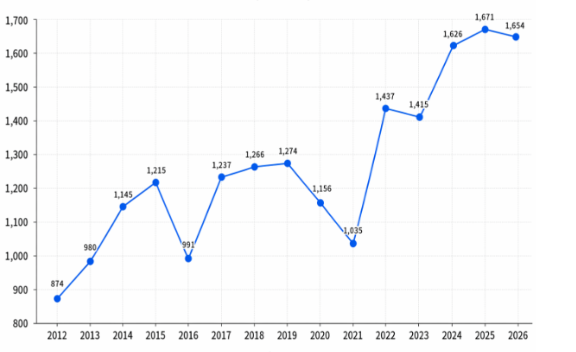
(Chart Placeholder: https://dubailand.gov.ae/en/open-data/#/ )
The chart above shows the historical trend of Dubai real estate prices. Compared to 10 years ago, the price per square foot has grown by 1.8 times, showing that Dubai real estate was previously in a bubble phase that it has now surpassed.
Why Dubai Real Estate is Unlikely to Crash Anytime Soon
As an investor, it is completely natural to worry that Dubai real estate might crash in the future. However, there are three main reasons why the Dubai real estate market can maintain its high levels.
High Praise for the UAE Government’s Crisis Management
Amidst growing tensions in the Middle East, the UAE government has strictly pursued an omnidirectional diplomatic approach, maintaining a neutral stance. Their calm and swift crisis management has been highly praised worldwide, cementing the UAE’s reputation as a safe haven.
<The UAE Government’s Crisis Response>
When Dubai International Airport Terminal 3 was impacted and roughly 20,000 people were stranded, the government immediately covered hotel stay costs, provided meals, and issued emergency visas.
The defense system recorded an astonishing 96% interception rate, proving its capability to keep damage to an absolute minimum.
By collaborating with retailers and utilizing digital systems, they monitored the inventory and prices of food and medicine in real-time to suppress panic buying.
A “Lehman Shock” Style Crash is Unlikely
Dubai’s real estate has crashed in the past. During the 2008 Lehman Shock and the 2009 Dubai Shock, many properties lost more than half their value. The reason was that back then, a large portion of buyers relied on mortgages.
However, the structure of the current Dubai real estate market is fundamentally different.
According to a study by Knight Frank, 87% of Dubai real estate buyers pay in cash.
Compared to countries like Japan or the US, this uniqueness is clear. Because so many people are buying properties with their own funds, it is highly unlikely that global interest rate hikes will lead to mortgage defaults and mass panic selling.
Strong Actual Demand from Foreign Expatriates
The current Dubai market is driven by actual demand. Attracted by the business environment and tax incentives, an increasing number of companies from around the world are relocating to Dubai and using it as a global crossroads.
The Dubai Chamber of Commerce reported that 53,838 new companies were established in the first three quarters (Jan-Sept) of 2025.
While the sheer number might seem smaller compared to Japan, a massive influx of AI and tech companies is driving this growth. Recently, industrial equipment manufacturer Eaton began constructing an engineering center spanning approximately 36,000 square meters. It is scheduled to be operational during 2026 and will create over 700 jobs. Against this backdrop, the number of foreign expatriates is rapidly surging.
Potential Risks of a Dubai Real Estate Crash
On the other hand, it is dangerous to ignore risks entirely. Oversupply, rising interest rates, and drastic changes in global affairs could become headwinds.
Price Collapse Due to Oversupply
Many new projects are being developed in Dubai. Even though the population is increasing, if housing supply excessively outpaces population growth, prices for undifferentiated properties may collapse, and vacancy rates could rise.
Applying the real estate cycle theory, some believe the market peaked around 2025. The era where the “entire market goes up” is over. Therefore, do not be overconfident; carefully select properties, analyze areas, and verify property management systems. Recently, an increasing number of investors are looking beyond Dubai, investing in Ras Al Khaimah (where a casino resort is being built) or Abu Dhabi’s Yas Island (where a Disney resort is planned).
Reduced Buying Appetite Due to Rising Interest Rates
Because the UAE Dirham is pegged to the US Dollar, local banks follow US interest rate policies. If inflation reignites in the US and interest rates rise, mortgage rates in Dubai will follow suit.
Even though cash purchases dominate the market, there are still buyers who rely on loans. We cannot ignore the possibility that the purchasing appetite of this demographic might cool down.
Worse-than-Expected Global Instability
The risk of the Middle East situation deteriorating far beyond expectations is not zero. While the entire world would take an economic hit, the Dubai economy could also suffer immense damage.
Frequently Asked Questions About Dubai Real Estate
Finally, here are some common questions we receive about Dubai real estate.
Q: Has Dubai real estate ever crashed in the past?
A: Yes, it has. During the 2008 Lehman Shock and the 2009 Dubai Shock, there was a wave of panic selling, and many properties plummeted to less than half their value.
However, as mentioned earlier, because the number of cash buyers has increased significantly, a “Lehman Shock-style” crash is considered highly unlikely today. Also, in the past, projects frequently stalled due to developers running out of funds.
Today, strict legal regulations enforced by the DLD (Dubai Land Department) and RERA (Real Estate Regulatory Agency) ensure that investor funds are completely separated from the developer’s operational funds, making fraud or embezzlement extremely difficult.
Q: Is now a good time to buy Dubai real estate?
A: It’s hard to give a blanket answer because it depends on your individual investment goals, financial situation, and risk tolerance. The Dubai real estate market has matured;
the “bonus stage” where any property in any area would increase in value is over. However, because the population continues to grow, properties that meet certain criteria—such as “good location (city center or waterfront),” “reputable major developer,” “guaranteed rental demand,” and “ongoing urban development”—can still target stable income gains and long-term capital gains. Please make your decisions alongside a trusted agent.
Q: Are there any properties being sold at rock-bottom prices due to the Middle East situation?
A: In areas targeted by Iranian retaliatory attacks, there are rare cases of panic selling. Properties listed at 50% off are immediately flooded with prospective buyers.
While there is a risk of being targeted by attacks, it is highly recommended for those who want to purchase property at exceptional prices.
On the other hand, due to a slight decrease in overall transaction volume, it has become possible to purchase developer off-plan properties a little cheaper.
Our current recommendation is a studio project priced at around 28 million JPY. If there is a new project you are interested in, now might be the perfect time to buy.
Conclusion
Despite anxiety surrounding the Middle East, Dubai real estate has not crashed. The likely reasons include:
- High praise for the UAE government’s crisis management.
- The unlikelihood of a Lehman Shock-style crash.
- The positive impact of the increasing number of business startups in Dubai.
However, it is completely natural to watch the daily news and worry, “Will Dubai real estate crash due to the worsening situation in the Middle East?” At JCME GROUP, we offer services including property valuation and tenant sourcing.
If you are worried about your current properties amidst the worsening regional situation, please feel free to consult with us. We also accept requests from those looking for properties sold at rock-bottom prices due to the current climate.